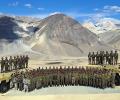
Her comments come a day after External Affairs Minister S Jaishankar said in Geneva that roughly 75 percent of the "disengagement problems" with China are sorted out but the bigger issue has been the increasing militarisation of the frontier.
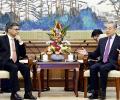
India and China held diplomatic talks in Beijing, focusing on effective border management and the resumption of cross-border cooperation and exchanges, including on trans-border rivers and the Kailash-Mansarovar Yatra. The meeting explored measures and proposals to implement decisions made during the Special Representatives (SR) dialogue in December. Both sides agreed to work together for the next SR meeting in India later this year.
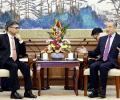
India and China have agreed to rebuild ties and resume people-to-people exchanges, including resuming direct flights and the Kailash Manasarovar Yatra this year. The two countries also discussed the resumption of dialogue mechanisms to address each other's concerns and move relations to a more stable path. The meeting comes after a period of strained relations following the Galwan Valley clashes in 2020.

National Security Advisor Ajit Doval on Monday emphasised the need to counter terrorism in all its forms for overall regional peace and stability during a meeting with Chinese Foreign Minister Wang Yi in Beijing.

China defended the BRICS economic alliance, stating it is not a bloc for confrontation, after former US President Donald Trump threatened tariffs on countries aligning with its 'anti-American policies'.
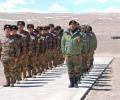
Chinese foreign ministry spokesperson Mao Ning told the media in Beijing on Monday that the two sides held an in-depth exchange of views on expediting the resolution of relevant issues.
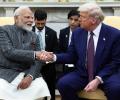
No one should make China an issue in their bilateral relations and their cooperation should not harm the interests of another country, the Chinese Foreign Ministry said on Friday reacting to queries on the meeting between Prime Minister Narendra Modi and United States President Trump.

China and Bhutan held the 15th Expert Group Meeting to discuss boundary alignment, focusing on areas where there are no disputes, and agreed to maintain the momentum of negotiations.

Vikram Doraiswami, a seasoned diplomat, has been appointed as India's new ambassador to China, succeeding Pradeep Kumar Rawat. This decision comes as both countries attempt to improve bilateral relations following a period of strain.

Instead, Chinese Premier and Xi's confidant Li Qiang will take part in the summit to be held on July 6-7 in which Prime Minister Narendra Modi was expected to take part.
'We remain in touch with the Chinese side, in Beijing as well as in Delhi, to bring predictability in the supply chain.'

The question and her reply did not figure in the official transcript of the media briefing posted on the Chinese foreign ministry website hours later.
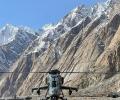
Defence sources stated that the disengagement involves removing infrastructure and withdrawing troops from both sides. The process is expected to be completed by Tuesday.
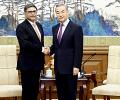
The Chinese Defence Ministry has stated that the Indian and Chinese militaries are implementing the resolutions to end the standoff in eastern Ladakh in a "compressive and effective manner." This follows the disengagement process completed late last year after a pact for troop withdrawal from Depsang and Demchok, the last two friction points in eastern Ladakh. The disengagement has paved the way for the resumption of various dialogue mechanisms between the two countries, with the aim of normalizing bilateral relations.

External Affairs Minister S Jaishankar is in Moscow on a four-day visit to attend the meeting of foreign ministers of the SCO of which both India and China are members.

The Indian and Chinese militaries held a fresh round of high-level military talks focusing on maintaining peace and security along the Line of Actual Control (LAC) in eastern Ladakh.

A Chinese diplomat's aggressive comments threatening the Japanese Prime Minister over remarks about Taiwan have ignited a diplomatic row between China and Japan.
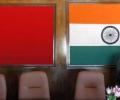
India and China have agreed to take measures to further ease the situation at the borders while continuing to implement the October agreement to resolve the standoff in eastern Ladakh comprehensively. The two sides held the 32nd meeting of the Working Mechanism for Consultation & Coordination on China-India Border Affairs (WMCC) in New Delhi, agreeing to maintain communication through diplomatic and military channels and safeguard sustainable peace and stability in the border areas. This meeting follows the October 21 agreement between the two countries to resolve the over four-year-long military standoff in eastern Ladakh.
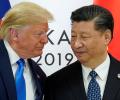
In a statement, the Chinese ministry of commerce said that it would file a lawsuit with the World Trade Organisation against the US for its "wrongful practice," the Global Times reported.
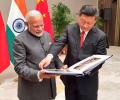
China's foreign ministry on Monday parried questions on a possible meeting between Prime Minister Narendra Modi and President Xi Jinping on the sidelines of the BRICS summit in Russia this week.
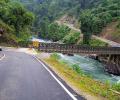
India on Wednesday outright rejected China's attempts to rename some places in Arunachal Pradesh, saying such 'preposterous' attempts will not alter the 'undeniable' reality that the state 'was, is, and will' always remain an integral part of India.

The LPG squeeze on India's restaurant sector is the quotidian face of a deeper crisis.

Egypt, Pakistan, Saudi Arabia and Turkey met in Islamabad in what analysts say is the formal opening of a new diplomatic formation that could reshape the post-war regional order. Their immediate goal is a ceasefire; their larger ambition is to ensure that neither Iran nor Israel emerges from this war in a dominant position. Pakistan's foreign minister then flew directly to Beijing and mooted a Chinese role as guarantor of any eventual agreement. Prem Panicker continues his must read daily blog on the Gulf War.
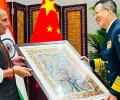
Defence Minister Rajnath Singh, in his meeting with Chinese counterpart Dong Jun in Qingdao on June 26, proposed that India and China should solve the "complex issues" under a structured roadmap comprising steps to de-escalate tensions along the frontiers and rejuvenate the existing mechanism to demarcate the borders.
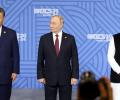
China has expressed its support for Russia's initiative to revive the Russia-India-China (RIC) troika, emphasizing its importance for regional and global security and stability.

China on Wednesday said the Chinese and Indian militaries are implementing the resolutions concerning the disengagement in eastern Ladakh along the Line of Actual Control (LAC) in an 'orderly' manner.
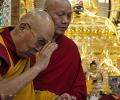
His successor issue is also expected to flare up fresh tensions between Beijing and Washington as China's policy comes in conflict with the US Tibetan Policy and Support Act of 2020, which reaffirmed America's steadfast support for the Dalai Lama and Tibetan Buddhism.

'Nehru was an idealist, he was certainly a visionary in one way, but Mao Zedong was not. Mao Zedong was a very down-to-earth strategist. He wanted to take Tibet, to take the plateau, to take the rivers, to take the minerals.'

Trump may strike. He may announce productive talks and extend again. He may do both at the same time. Iran will not open the Strait on someone else's terms, so no matter what happens, that problem will remain unsolved. And the IRGC will still be collecting its $2 million toll from every ship bold enough to ask permission to pass.

Since June, India's ministry of external affairs has intensified its diplomatic calendar, hosting several heads of state and government, foreign ministers, and key trade delegations.

Alliances fight wars effectively only when they share an endgame. If Israel acted without US knowledge, then the military alliance is operating without real coordination at the level of strategic targeting. Neither picture is reassuring in a war that is no longer regional in its consequences. Prem Panicker continues his must read daily blog on the Gulf War.

China dismissed the reports as groundless.
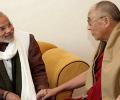
China has protested to India over Prime Minister Narendra Modi's greetings to the Dalai Lama on his 90th birthday and the attendance of Indian officials at the celebrations, stressing New Delhi should appreciate Beijing's sensitivities on Tibet-related issues.

China has objected to Indian Minister Kiren Rijiju's remarks on the Dalai Lama's reincarnation, urging India to be cautious on Tibet-related issues to avoid impacting bilateral relations. China insists any future Dalai Lama must receive its approval.

China has defended its newly-released AI tool DeepSeek, after several countries, including India, imposed restrictions on government officials accessing it. Beijing claims actions against DeepSeek amount to "politicisation" of trade and tech issues and vowed to protect the interests of its companies. India's Finance Ministry directed officials to avoid using DeepSeek on office devices, citing confidentiality risks. The tool has garnered global attention for its low-cost model and efficient use of resources, surpassing ChatGPT in popularity on Apple's Appstore.
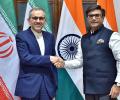
India's Foreign Secretary Vikram Misri will travel to Beijing for a two-day trip beginning Sunday, marking the second high-profile visit from India to China in less than one-and-a-half months. The visit comes amidst ongoing border tensions and follows a recent disengagement pact between the two countries in eastern Ladakh. The Foreign Secretary-Vice Minister mechanism meeting will focus on the next steps for India-China relations, including in the political, economic, and people-to-people domains. The decision to revive this bilateral mechanism was taken at a meeting between Prime Minister Narendra Modi and Chinese President Xi Jinping in Kazan in October.

The car exploded near the embassy in Bishkek, killing its driver and wounding three people.

India has been raising with China the plight of approximately 22,000 Indian students enrolled in Chinese universities who are unable to go back for physical classes. However, the neighbouring country has till date refused to let them enter.

Prime Minister Narendra Modi on Sunday conveyed to Iranian President Masoud Pezeshkian India's 'deep concern' over Iran's conflict with Israel and called for immediate de-escalation of the situation through 'dialogue and diplomacy'.
China on Tuesday called for a 'comprehensive and lasting ceasefire' between India and Pakistan, urging both countries to properly handle their differences through dialogue.
